
Autism Disorder Diagnosis Enhancement Using Adaptive Ranking Features and Machine Learning Classifiers
DOI:
https://doi.org/10.58564/IJSER.5.1.2026.364Keywords:
Autism disorders, Classifiers, Feature Ranking, Machine Learning. Deep LearningAbstract
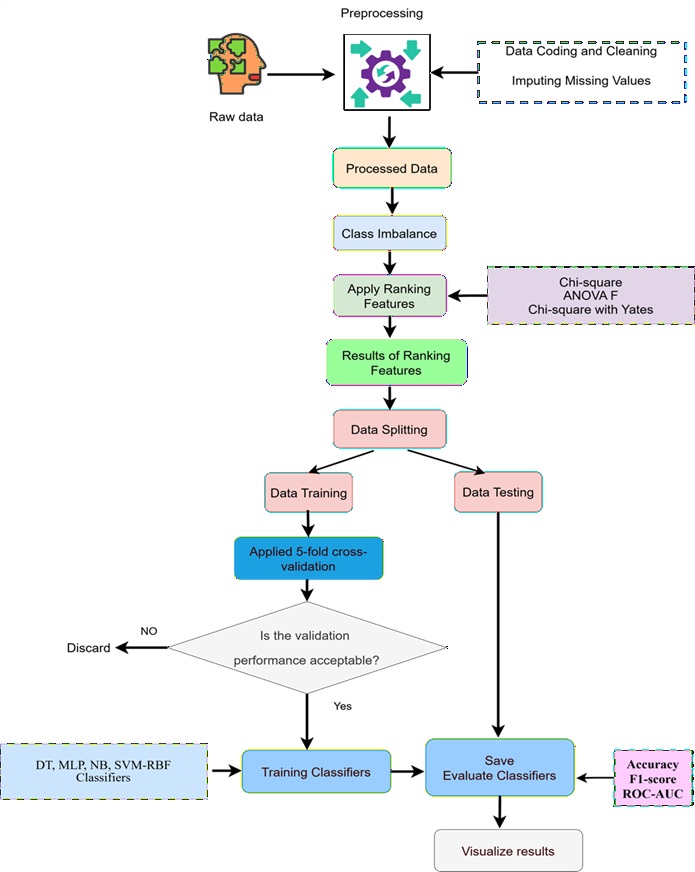
Autism is a disorder of brain function that can appear in children younger than two years and affects their communication and learning. The incidence of Autism in children has been increasing, and at the same time, numerous schemes have been proposed for its diagnosis. However, the researchers continue to face challenges in the early and accurate diagnosis of Autism. Early and accurate detection of autism allows doctors to determine the severity of the disease and begin appropriate treatment protocols to develop communication skills in children. This paper proposes feature ranking methods integrated with four classifiers for the accurate diagnosis of autism. Multiple experiments are conducted by integrating ranking features methods (chi-square, Anova-F, and chi2-yates) with Decision Tree (DT), Multi-layer perceptron (MLP), NaiveBayes Bernoulli (NB), and Support Vector Machine –Radial Basis Function (SVM-RBF) classifiers to achieve accurate early detection. The feature ranking is applied with five sets (5, 10, 20, 40, and 46), and each set is individually evaluated to assess its contribution to autism diagnosis. The best diagnosis model (chi2-yates-based SVM-RBF) has achieved 0.971611, 0.94797, and 0.997335 for the accuracy, F1-score, and ROC-AUC, respectively. The proposed framework would be effective in helping therapists in early detection and selecting suitable treatment for autism.
References
[1] M. E. Alqaysi, A. S. Albahri, and R. A. Hamid, “Hybrid Diagnosis Models for Autism Patients Based on Medical and Sociodemographic Features Using Machine Learning and Multicriteria Decision-Making (MCDM) Techniques: An Evaluation and Benchmarking Framework,” Comput. Math. Methods Med., vol. 2022, 2022, doi: 10.1155/2022/9410222. DOI: https://doi.org/10.1155/2022/9410222
[2] M. E. Alqaysi, A. S. Albahri, and R. A. Hamid, “Review Article Diagnosis-Based Hybridization of Multimedical Tests and Sociodemographic Characteristics of Autism Spectrum Disorder Using Artificial Intelligence and Machine Learning Techniques : A Systematic Review,” vol. 2022, 2022. DOI: https://doi.org/10.1155/2022/3551528
[3] M. Sharma, “Improved autistic spectrum disorder estimation using Cfs subset with greedy stepwise feature selection technique,” Int. J. Inf. Technol., vol. 14, no. 3, pp. 1251–1261, 2022, doi: 10.1007/s41870-019-00335-5. DOI: https://doi.org/10.1007/s41870-019-00335-5
[4] R. Ara, P. Saha, D. Bala, S. M. R. Ul, I. Abdullah, and B. Saha, “Healthcare Analytics An evaluation of machine learning approaches for early diagnosis of autism spectrum disorder,” vol. 5, no. January, 2024. DOI: https://doi.org/10.1016/j.health.2023.100293
[5] S. G. Jacob, M. Mohammed, B. Ali, and B. Bennet, “Feature Signature Discovery for Autism Detection : An Automated Machine Learning Based Feature Ranking Framework,” vol. 2023, 2023, doi: 10.1155/2023/6330002. DOI: https://doi.org/10.1155/2023/6330002
[6] T. Dhamale et al., “Autism Spectrum Disorder Detection Using Parallel DCNN with Improved Teaching Learning Optimization Feature Selection Scheme,” vol. 116, no. September, pp. 89–100, 2025. DOI: https://doi.org/10.23919/SAIEE.2025.11090064
[7] P. Radoˇ and G. Martinovi, “Emotion Recognition in Autistic Children Through Facial Expressions Using Advanced Deep Learning Architectures,” pp. 1–16, 2025.
[8] A. Rana, “DL-ASD : A Deep Learning Approach for Autism Spectrum Disorder,” 2022 5th Int. Conf. Contemp. Comput. Informatics, pp. 1767–1770, 2022, doi: 10.1109/IC3I56241.2022.10072429. DOI: https://doi.org/10.1109/IC3I56241.2022.10072429
[9] H. Selcuk and N. Hojjat, “Multiple Classification of Brain MRI Autism Spectrum Disorder by Age and Gender Using Deep Learning,” J. Med. Syst., vol. 48, no. 1, pp. 1–12, 2024, doi: 10.1007/s10916-023-02032-0. DOI: https://doi.org/10.1007/s10916-023-02032-0
[10] A. Singh, K. Raj, T. Kumar, S. Verma, and A. M. Roy, “Deep Learning-Based Cost-Effective and Responsive Robot for Autism Treatment,” pp. 1–18, 2023. DOI: https://doi.org/10.3390/drones7020081
[11] K. P. Lenker, Y. Li, J. F. Susan, and D. M. Susan, “Autism Spectrum Disorder Phenotypes Based on Sleep Dimensions and Core Autism Symptoms,” J. Autism Dev. Disord., pp. 1–13, 2025. DOI: https://doi.org/10.1007/s10803-025-06822-y
[12] A. Ibrahim, S. Kumar, and A. Raza, “Capsule DenseNet ++ : Enhanced autism detection framework with deep learning and reinforcement learning-based lifestyle recommendation,” Comput. Biol. Med., vol. 190, p. 110038, 2025, doi: 10.1016/j.compbiomed.2025.110038. DOI: https://doi.org/10.1016/j.compbiomed.2025.110038
[13] D. S. Sujana and D. P. Augustine, “FaithfulNet : An explainable deep learning framework for autism diagnosis using structural MRI ☆,” Brain Res., p. 149904, 2025, doi: 10.1016/j.brainres.2025.149904. DOI: https://doi.org/10.1016/j.brainres.2025.149904
[14] N. Rai, P. C. Pradhan, H. Saikia, and R. Bhutia, “ASD-HybridNet : A hybrid deep learning framework for detection of autism spectrum disorder,” Magn. Reson. Imaging, vol. 124, no. May, p. 110492, 2025, doi: 10.1016/j.mri.2025.110492. DOI: https://doi.org/10.1016/j.mri.2025.110492
[15] X. Wang, C. Pei, J. He, and J. Xu, “Neuroscience A deep learning model for diagnosing autism using brain time series,” Neuroscience, vol. 583, no. March, pp. 120–135, 2025, doi: 10.1016/j.neuroscience.2025.08.001. DOI: https://doi.org/10.1016/j.neuroscience.2025.08.001
[16] G. Leroy, P. Bisht, S. Madhuri, N. Maltman, and S. Rice, “Deep learning for autism detection using clinical notes : A comparison of transfer learning for a transparent and black-box approach,” Artif. Intell. Med., vol. 172, p. 103318, 2026, doi: 10.1016/j.artmed.2025.103318. DOI: https://doi.org/10.1016/j.artmed.2025.103318
[17] A. S. Abdullah, V. Keerthana, S. Geetha, and U. Mishra, “Results in Engineering Leveraging deep learning for enhanced diagnosis of autism spectrum disorder using resting-state functional magnetic resonance imaging and clinical data,” Results Eng., vol. 25, p. 104444, 2025, doi: 10.1016/j.rineng.2025.104444. DOI: https://doi.org/10.1016/j.rineng.2025.104444
[18] I. Araf, A. Idri, and I. Chairi, Cost ‑ sensitive learning for imbalanced medical data : a review, vol. 57, no. 4. Springer Netherlands, 2024. doi: 10.1007/s10462-023-10652-8. DOI: https://doi.org/10.1007/s10462-023-10652-8
[19] H. Almarwi and G. H. Al-gaphari, “A Review of Feature Selection Methods in Big Data,” pp. 0–2, 2024.
Downloads
Published
How to Cite
Issue
Section
License
Copyright (c) 2026 Heba Ahmed Jassim, Maysam Kadhim, Hafsa Amer Jasim, Zahraa Khduair Taha

This work is licensed under a Creative Commons Attribution-ShareAlike 4.0 International License.