
Seismic Response Optimization of RC Slabs: Influence of Opening Location, Size, and Geometry on Structural Performance
DOI:
https://doi.org/10.58564/IJSER.5.1.2026.363Keywords:
concrete slab, seismic performance, finite element method, ABAQUS software, dynamic time history analysisAbstract
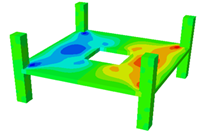
In this research, the influence of the location, area and shape of the openings on the seismic behavior and performance of the concrete slab roof was evaluated and studied using the finite element numerical method, and recommendations were given for the optimal design. In order to model and analyze slab samples and perform parametric studies, ABAQUS software was used in this research. Studies were carried out based on different parameters such as different positions of the opening in the slab, the placement of the opening in the corner-side-center of the slab, different ratios of the area of the opening to the area of the slab, to be less than and more than 50% and finally different forms of the opening. In order to evaluate the seismic behavior of the slab, the time history dynamic analysis method was used based on the Tabas (Iran) earthquake record. The results of the analysis showed that for the opening located in the corner and on the side of the slab, the conditions were critical, and for the opening located on the edge of the slab (side of the slab), the conditions were more critical. Also, the results showed that the presence of an opening on the side of the slab increased the energy, force and shear caused by the earthquake to at least 40% compared to other positions of the opening in the slab, and as a result, the most critical conditions related to the placement of the opening in the slab It is considered the edge of the slab. Also, the results of the analysis showed that in the case where the opening surface is more than 50% (slab with a large opening), the condition of the slab's vulnerability is lower, but the maximum energy of the slab with a larger opening is always up to 60% more than the slab with a small opening. Of course, this energy level is related to the early times of the earthquake, and finally, the high ductility of the slab with a larger opening can include better seismic behavior and performance of the slab. Finally, the results of the analysis showed that circular and oval openings and, in general, openings with curved and non-sharp corners have better seismic conditions and performance and experience lower energy values. Trapezoidal opening has better conditions in irregular trapezoidal slabs and square opening has the highest amount of energy among different opening shapes, which is not desirable.
References
[1] Anas, S. M., Shariq, M., Alam, M., Yosri, A. M., Mohamed, A., & AbdelMongy, M. (2023). Influence of supports on the low-velocity impact response of square rc slab of standard concrete and ultra-high-performance concrete: FEM-Based Computational Analysis. Buildings, 13(5), 1220.
[2] Wahab, S., Mahmoudabadi, N. S., Waqas, S., Herl, N., Iqbal, M., Alam, K., & Ahmad, A. (2024). Comparative Analysis of Shear Strength Prediction Models for Reinforced Concrete Slab–Column Connections. Advances in Civil Engineering, 2024(1), 1784088.
[3] Xu, X., Su, Y., & Feng, Y. (2024). Optimization analysis of state equation and failure criterion for concrete slab subjected to impact loading. International Journal of Impact Engineering, 186, 104872.
[4] Wang, R., Fang, Z., Lezgy-Nazargah, M., & Khosravi, H. (2023). Nonlinear analysis of reinforced concrete slabs using a quasi-3D mixed finite element formulation. Engineering Structures, 294, 116781. DOI: https://doi.org/10.1016/j.engstruct.2023.116781
[5] Bolina, F. L., & Rodrigues, J. P. C. (2023). Finite element analysis criteria for composite steel decking concrete slabs subjected to fire. Fire Safety Journal, 139, 103818. DOI: https://doi.org/10.1016/j.firesaf.2023.103818
[6] Grabski, M., & Ambroziak, A. (2023). Experimental and analytical analysis of punching shear in flat slabs supported on column topped with concrete head. Construction and Building Materials, 364, 129961.
[7] Attallah, I. A. (2023). Finite Element Modelling and Parametric Analysis of High Strength Thin Reinforced Concrete Slabs Strengthened by CFRP Laminates. ERJ. Engineering Research Journal, 46(1), 89-98.
[8] Awasthi, A., Satbhaiya, R., & Scholar, P. G. (2023). Seismic Analysis of Flat Slab Structure Using ETABS Software. International Journal of Scientific Research in Civil Engineering, 7(2), 129-146.
[9] Genikomsou, A. S. (2024). Seismic Damage Assessment of Reinforced Concrete Slab-Column Connections—Review of Test Data, Code Provisions and Analytical Models. Buildings, 14(2), 465.
[10] Abd-Elhamed, A., Mahmoud, S., & Alotaibi, K. S. (2023). Nonlinear analysis of reinforced concrete buildings with different heights and floor systems. Scientific Reports, 13(1), 14949.
[11] Anas, S. M., Shariq, M., Alam, M., Yosri, A. M., Mohamed, A., & AbdelMongy, M. (2023). Influence of supports on the low-velocity impact response of square RC slab of standard concrete and ultra-high-performance concrete: FEM-based computational analysis. Buildings, 13(5), 1220. https://doi.org/10.3390/buildings13051220 DOI: https://doi.org/10.3390/buildings13051220
[12] Grabski, M., & Ambroziak, A. (2023). Experimental and analytical analysis of punching shear in flat slabs supported on column topped with concrete head. Construction and Build-ing Materials, 364, 129961. https://doi.org/10.1016/j.conbuildmat.2022.129961 DOI: https://doi.org/10.1016/j.conbuildmat.2022.129961
[13] Genikomsou, A. S. (2024). Seismic damage assessment of reinforced concrete slab-column connections—Review of test data, code provisions and analytical models. Buildings, 14(2), 465. https://doi.org/10.3390/buildings14020465 DOI: https://doi.org/10.3390/buildings14020465
[14] Abd-Elhamed, A., Mahmoud, S., & Alotaibi, K. S. (2023). Nonlinear analysis of rein-forced concrete buildings with different heights and floor systems. Scientific Reports, 13(1), 14949. https://doi.org/10.1038/s41598-023-42052-9 DOI: https://doi.org/10.1038/s41598-023-41656-7
[15] Xu, X., Su, Y., & Feng, Y. (2024). Optimization analysis of state equation and failure criterion for concrete slab subjected to impact loading. International Journal of Impact En-gineering, 186, 104872. https://doi.org/10.1016/j.ijimpeng.2023.104872 DOI: https://doi.org/10.1016/j.ijimpeng.2023.104872
[16] Attallah, I. A. (2023). Finite element modelling and parametric analysis of high strength thin reinforced concrete slabs strengthened by CFRP laminates. Engineering Research Jour-nal, 46(1), 89–98. https://doi.org/10.21608/erjm.2023.303862
[17] Wahab, S., Mahmoudabadi, N. S., Waqas, S., Herl, N., Iqbal, M., Alam, K., & Ahmad, A. (2024). Comparative analysis of shear strength prediction models for reinforced concrete slab–column connections. Advances in Civil Engineering, 2024(1), 1784088. https://doi.org/10.1155/2024/1784088 DOI: https://doi.org/10.1155/2024/1784088
[18] G. O. Young, “Synthetic structure of industrial plastics (Book style with paper title and editor),” in Plastics, 2nd ed. vol. 3, J. Peters, Ed. New York: McGraw-Hill, 1964, pp. 15–64.
[19] W.-K. Chen, Linear Networks and Systems (Book style). Belmont, CA: Wadsworth, 1993, pp. 123–135.
[20] H. Poor, An Introduction to Signal Detection and Estimation. New York: Springer-Verlag, 1985, ch. 4.
[21] B. Smith, “An approach to graphs of linear forms (Unpublished work style),” unpublished.
[22] E. H. Miller, “A note on reflector arrays (Periodical style—Accepted for publication),” IEEE Trans. Antennas Propagat., to be published.
[23] J. Wang, “Fundamentals of erbium-doped fiber amplifiers arrays (Periodical style—Submitted for publication),” IEEE J. Quantum Electron., submitted for publication.
Downloads
Published
How to Cite
Issue
Section
License
Copyright (c) 2026 Ali S. Ali Abed, Yasir W. Abduljaleel Abed, Bilal Al-Obaidi Abed

This work is licensed under a Creative Commons Attribution-ShareAlike 4.0 International License.