
Thermodynamic Assessment of an Integrated PDSC–TES–AMTEC–TEG Solar Micro-CHP System
DOI:
https://doi.org/10.58564/IJSER.5.3.2026.376Keywords:
Alkali metal thermal-to-electric converter, Micro-combined heat and power, Parabolic dish solar concentrator, Thermal energy storage, Thermoelectric generatorAbstract
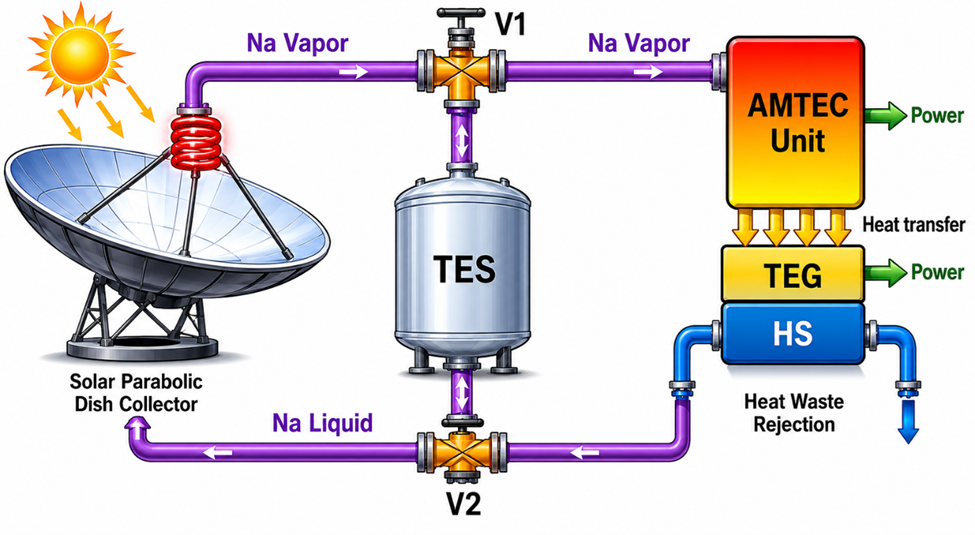
Decentralized renewable energy systems that generate electricity as well as useful heat have been gaining more attention as efficient alternatives to traditional fossil-fuel energy systems. This study reports a thermodynamic analysis of a solid-state solar micro-combined heat and power (mCHP) system that uses an alkali metal thermal-to-electric converter, latent thermal energy storage, a thermoelectric generator, and a parabolic dish solar concentrator. The configuration is designed to optimize solar energy use, integrating high-temperature solar heat collection, thermal storage, direct thermal-to-electric conversion, and waste heat recovery into a compact and modular system. The performance of the integrated system was analyzed using the methods of energy and exergy analysis, and the main sources of irreversibilities were identified. Suitable operating conditions were investigated by studying the effects of the key operating parameters such as receiver wall temperature, AMTEC current, condenser temperature, and TEG current. The results indicate that the proposed system can produce a total electrical power of 7372 W, including 6241 W from the AMTEC and 1131 W from the TEG, as well as useful heating power of 8242 W at 80 °C. The efficiencies for electrical and overall CHP are 24.75% and 52.05%, respectively. Moreover, the electrical exergy efficiency and overall exergy efficiency are 26.4% and 31.01%, respectively, and the overall rate of exergy destruction is 19231 W. From the exergy analysis it is seen that the solar collection stage is the largest source of irreversibility. The proposed PDSC–TES–AMTEC–TEG system has good potential for use as a dependable, modular, and fully solid-state solar micro-CHP system for decentralized energy applications.
References
[1] A. H. Alami, A. G. Olabi, A. Mdallal, A. Rezk, A. Radwan, S. M. A. Rahman, et al., “Concentrating solar power (CSP) technologies: Status and analysis,” International Journal of Thermofluids, vol. 18, 2023, Art. no. 100340, doi: 10.1016/j.ijft.2023.100340.
[2] C. Wu, Y. Zhao, W. Li, J. Fan, H. Xu, Z. Ling, D. Yuan, and X. Zeng, “Concentrated solar thermal power technology and its thermal applications,” Energies, vol. 18, no. 8, p. 2120, 2025.
[3] O. K. Çakır, Ş. Ela, and M. Ekmekçi, “A comprehensive review of concentrated solar power technologies: Operating principles, efficiency analyses, and energy storage capabilities of tower, parabolic trough, Dish-Stirling, and Fresnel systems,” International Journal of Energy Studies, vol. 10, no. 4, pp. 1807–1835, 2025.
[4] J. García-Ferrero, R. P. Merchán Corral, J. A. Moctezuma-Hernández, D. Pérez-Gallego, S. Anvari, J. González-Ayala, A. Calvo-Hernández, J. M. Mateos Roco, M. J. Santos, and A. Medina, “Parabolic Dish Collectors for Concentrated Solar Power: A Comprehensive Review on Their Subsystems and Overall Integration,” Energies, vol. 18, no. 24, p. 6596, 2025.
[5] K. H. Kumar, A. M. Daabo, M. K. Karmakar, and H. Hirani, “Solar parabolic dish collector for concentrated solar thermal systems: A review and recommendations,” Environmental Science and Pollution Research, vol. 29, 2022, doi: 10.1007/s11356-022-18586-4.
[6] P. Esfanjani, A. Mahmoudi, S. Rashidi, M. S. Valipour, and W. M. Yan, “A review on phase change material’s applications in solar parabolic dish collectors,” Journal of Thermal Analysis and Calorimetry, vol. 149, pp. 13533–13549, 2024, doi: 10.1007/s10973-024-13724-1.
[7] M. Opolot, C. Zhao, M. Liu, S. Mancin, F. Bruno, and K. Hooman, “A review of high temperature (≥ 500 °C) latent heat thermal energy storage,” Renewable and Sustainable Energy Reviews, vol. 160, 2022, Art. no. 112293, doi: 10.1016/j.rser.2022.112293.
[8] G. Wang, S. Pang, and T. Jiang, “A brief review of liquid heat transfer materials used in concentrated solar power systems and thermal energy storage devices of concentrated solar power systems,” Engineering Reports, vol. 5, 2023, pp. 1–20, doi: 10.1002/eng2.12576.
[9] M. J. Li, M. J. Li, R. Jiang, S. Du, and X. Y. Li, “Study on the dynamic characteristics of a concentrated solar power plant with the supercritical CO2 Brayton cycle coupled with different thermal energy storage methods,” Energy, vol. 288, 2024, Art. no. 129628, doi: 10.1016/j.energy.2023.129628.
[10] Z. Kee, J. Coventry, and J. Pye, “Boiling sodium and melting salt: Evaluation and optimisation of a novel solar–thermal system concept,” Applied Thermal Engineering, vol. 218, 2023, Art. no. 119165, doi: 10.1016/j.applthermaleng.2022.119165.
[11] F. Tohidi, S. Ghazanfari Holagh, and A. Chitsaz, “Thermoelectric Generators: A comprehensive review of characteristics and applications,” Applied Thermal Engineering, vol. 201, 2022, Art. no. 117793, doi: 10.1016/j.applthermaleng.2021.117793.
[12] W. Peng, J. Gonzalez-Ayala, G. Su, J. Chen, and A. C. Hernández, “Solar-driven sodium thermal electrochemical converter coupled to a Brayton heat engine: Parametric optimization,” Renewable Energy, vol. 164, pp. 260–271, 2021, doi: 10.1016/j.renene.2020.09.084.
[13] F. Tohidi, S. Khalilarya, A. Chitsaz, and A. Saberi Mehr, “Synergistic integration of alkali metal thermal electric converters and thermoelectric generators: A path to high-efficiency, static conversion of heat to electricity,” Thermal Science and Engineering Progress, vol. 54, 2024, Art. no. 102879, doi: 10.1016/j.tsep.2024.102879.
[14] W. Peng, J. Gonzalez-Ayala, J. Guo, J. Dong, and Q. Qin, “A two-stage sodium converter coupled to a two-stage TEG: Parametric optimization,” Applied Thermal Engineering, vol. 229, 2023, Art. no. 120560, doi: 10.1016/j.applthermaleng.2023.120560.
[15] Y. Zhao, Y. Huang, and Z. Chen, “Performance optimization of a solar-driven alkali metal thermoelectric converter coupled to thermally regenerative electrochemical cycles,” Applied Thermal Engineering, vol. 219, 2023, Art. no. 119569, doi: 10.1016/j.applthermaleng.2022.119569.
[16] S. Y. Wu, L. Xiao, Y. Cao, and Y. R. Li, “A parabolic dish/AMTEC solar thermal power system and its performance evaluation,” Applied Energy, vol. 87, no. 2, pp. 452–462, 2010, doi: 10.1016/j.apenergy.2009.08.041.
[17] J.-M. Tournier and M. El-Genk, “Design optimization of high-power, liquid anode AMTEC,” in AIP Conference Proceedings, vol. 654, 2003, pp. 740–750, doi: 10.1063/1.1541362.
[18] M. Liao, Z. He, C. Jiang, X. Fan, Y. Li, and F. Qi, “A three-dimensional model for thermoelectric generator and the influence of Peltier effect on the performance and heat transfer,” Applied Thermal Engineering, vol. 133, pp. 493–500, 2018, doi: 10.1016/j.applthermaleng.2018.01.080.
[19] E. Bellos and C. Tzivanidis, “Optimum design of a solar ejector refrigeration system for various operating scenarios,” Energy Conversion and Management, vol. 154, pp. 11–24, 2017, doi: 10.1016/j.enconman.2017.10.057.
[20] J.-M. Tournier, M. S. El-Genk, M. Schuller, and P. Hausgen, “An analytical model for liquid-anode and vapor-anode AMTEC converters,” in Space Technology and Applications International Forum (STAIF-97), 1997, pp. 1543–1552, doi: 10.1063/1.51977.
[21] M. A. Ryan, “Lifetimes of AMTEC electrodes: Molybdenum, rhodium-tungsten, and titanium nitride,” in AIP Conference Proceedings, vol. 504, 2000, pp. 1377–1382, doi: 10.1063/1.1290954.
[22] S. Shittu, G. Li, X. Zhao, X. Ma, Y. G. Akhlaghi, and Y. Fan, “Comprehensive study and optimization of concentrated photovoltaic-thermoelectric considering all contact resistances,” Energy Conversion and Management, vol. 205, Art. no. 112422, 2020, doi: 10.1016/j.enconman.2019.112422.
Downloads
Published
How to Cite
Issue
Section
License
Copyright (c) 2026 Ahmed Faeq Mohammed

This work is licensed under a Creative Commons Attribution-ShareAlike 4.0 International License.