
EEG-Based Detection of Alzheimer's Disease: A Bibliometric Analysis
DOI:
https://doi.org/10.58564/IJSER.5.3.2026.375Keywords:
Alzheimer's disease detection (ADD), bibliometric analysis, EEG, Deep Learning.Abstract
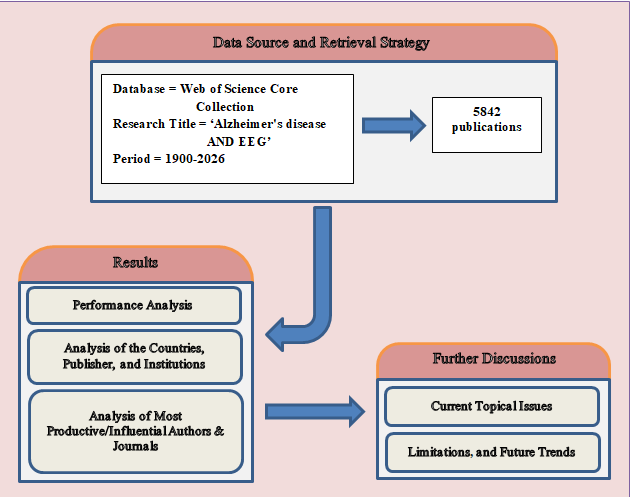
Alzheimer’s disease (AD) is a progressive brain disorder commonly seen in older adults. It leads to memory loss, cognitive decline, and eventually affects a person's ability to perform everyday tasks. Over time, it can become life-threatening, and its prevalence has been rising significantly. One widely used approach for detecting AD is through electroencephalography (EEG), which measures electrical activity in the brain. This paper contains an overview of detecting Alzheimer’s disease (AD) with EEG in a bibliometric analysis on the publication statistics provided from the Web of Science (WoS) database. This analysis includes basic statistical inferences on the publication counts, yearly distributions, citation performances, distribution on indexing, publication title, countries, etc., in a comparative manner to outline how EEG-based diagnosis differs from the general AD detection studies.
References
[1] D. V. Puri, S. L. Nalbalwar, A. B. Nandgaonkar, J. P. Gawande, and A. Wagh, ‘‘Automatic detection of Alzheimer’s disease from EEG signals using low-complexity orthogonal wavelet filter banks,’’ Biomed. Signal Process. Control, vol. 81, Mar. 2023, Art. no. 104439, doi: 10.1016/j.bspc.2022.104439.
[2] M. Fernández, A. L. Gobartt, and M. Balañá, ‘‘Behavioural symptoms in patients with Alzheimer’s disease and their association with cognitive impairment,’’ BMC Neurol., vol. 10, no. 1, p. 87, Dec. 2010, doi: 10.1186/1471-2377-10-87.
[3] A. Atri, ‘‘The Alzheimer’s disease clinical spectrum: diagnosis and management,’’ Med. Clinics North Amer., vol. 103, no. 2, pp. 263–293, Mar. 2019, doi: 10.1016/j.mcna.2018.10.009.
[4] Y. Ding, Y. Chu, M. Liu, Z. Ling, S. Wang, X. Li, and Y. Li, ‘‘Fully automated discrimination of Alzheimer’s disease using resting-state electroencephalography signals,’’ Quant. Imag. Med. Surgery, vol. 12, no. 2, pp. 1063–1078, Feb. 2022, doi: 10.21037/qims-21-430.
[5] L. A. Coben, W. L. Danziger, and L. Berg, “Frequency analysis of the resting EEG in Alzheimer's disease and multi-infarct dementia,” Electroencephalography and Clinical Neurophysiology, vol. 53, no. 6, pp. 662–673, 1982.
[6] E. Aljanabi and I. Turker, “EEG-based autism spectrum disorder detection: A bibliometric analysis,” Selcuk University Journal of Engineering Sciences, vol. 22, no. 2, pp. 55–61, 2023.
[7] M. E. Falagas, E. I. Pitsouni, G. A. Malietzis, and G. Pappas, “Comparison of PubMed, Scopus, Web of Science, and Google Scholar: strengths and weaknesses,” FASEB Journal, vol. 22, no. 2, pp. 338–342, 2008.
[8] K. Zhang and Q. M. Liang, “Recent progress of cooperation on climate mitigation: A bibliometric analysis,” Journal of Cleaner Production, vol. 277, p. 123495, 2020, doi: 10.1016/j.jclepro.2020.123495.
[9] J. Ling, X. M. Li, and M. W. Lin, “Medical waste treatment station selection based on linguistic q-rung orthopair fuzzy numbers,” CMES-Computer Modeling in Engineering & Sciences, vol. 129, no. 1, pp. 117–148, 2021.
[10] D. Yu, Z. Xu, Y. Kao, and C. T. Lin, “The structure and citation landscape of IEEE transactions on fuzzy systems (1994–2015),” IEEE Transactions on Fuzzy Systems, vol. 26, no. 2, pp. 430–442, 2017.
[11] D. Yu, Z. Xu, W. Pedrycz, and W. Wang, “Information sciences 1968–2016: A retrospective analysis with text mining and bibliometric,” Information Sciences, vol. 418, pp. 619–634, 2017.
[12] P. R. Mourão and V. D. Martinho, “Choosing the best socioeconomic nutrients for the best trees: A discussion about the distribution of Portuguese trees of public interest,” Environment, Development and Sustainability, vol. 23, no. 4, pp. 5985–6001, 2021.
[13] M. J. Cobo, M. A. Martinez, M. Gutierrez-Salcedo, H. Fujita, and E. Herrera-Viedma, “25 years at knowledge-based systems: A bibliometric analysis,” Knowledge-Based Systems, vol. 80, pp. 3–13, 2015.
[14] N. van Eck and L. Waltman, “Software survey: VOSviewer, a computer program for bibliometric mapping,” Scientometrics, vol. 84, no. 2, pp. 523–538, 2010.
[15] C. Chen, “CiteSpace II: Detecting and visualizing emerging trends and transient patterns in scientific literature,” Journal of the American Society for Information Science and Technology, vol. 57, no. 3, pp. 359–377, 2006.
[16] M. Aria and C. Cuccurullo, “Bibliometrix: An R-tool for comprehensive science mapping analysis,” Journal of Informetrics, vol. 11, no. 4, pp. 959–975, 2017.
[17] M. Lin, Y. Chen, and R. Chen, “Bibliometric analysis on Pythagorean fuzzy sets during 2013–2020,” International Journal of Intelligent Computing and Cybernetics, vol. 14, no. 2, pp. 104–121, 2021.
[18] K. Stopar and T. Bartol, “Digital competences, computer skills and information literacy in secondary education: mapping and visualization of trends and concepts,” Scientometrics, vol. 118, no. 2, pp. 479–498, 2019.
[19] Y. Chen, M. Lin, and D. Zhuang, “Wastewater treatment and emerging contaminants: Bibliometric analysis,” Chemosphere, vol. 297, p. 133932, 2022.
[20] D. Yu and C. Xu, “Mapping research on carbon emissions trading: a co-citation analysis,” Renewable and Sustainable Energy Reviews, vol. 74, pp. 1314–1322, 2017.
Downloads
Published
How to Cite
Issue
Section
License
Copyright (c) 2026 Ehssan AL Janabi Sciences

This work is licensed under a Creative Commons Attribution-ShareAlike 4.0 International License.