
Performance Evaluation of Z-Source Inverter Under Different Conditions
DOI:
https://doi.org/10.58564/IJSER.5.3.2026.374Keywords:
Z-source inverter, Boost Converter, Pulse Width Modulation (PWM), Load Regulation, Total Harmonic Distortion (THD)Abstract
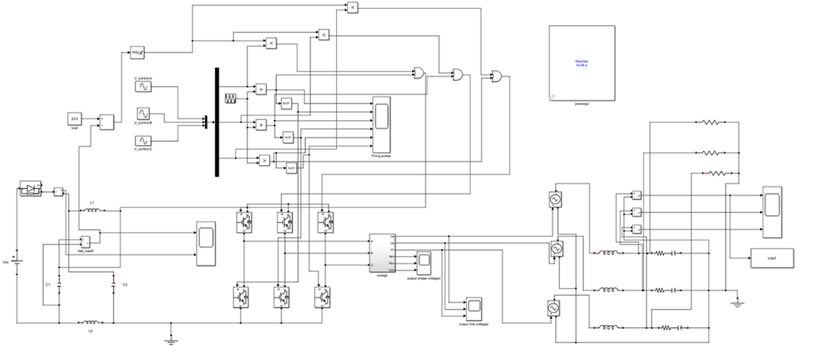
A suggested PI-controlled closed-loop Z-source inverter (ZSI) constructed in MATLAB/Simulink is presented in this research and evaluated under various conditions. The ZSI topology is suitable for renewable energy systems because it provides single-stage buck-boost operation through shoot-through, unlike traditional inverters such as VSI and CSI, which require additional converter stages. This paper investigated the impact of switching frequency, modulation factor, and load resistance on output voltage and total harmonic distortion (THD). Simulation results show that the output voltage remains constant at 209 V while THD decreases from 0.47% to 0.17% when switching frequency increases from 2 kHz to 10 kHz. Furthermore, the output voltage reaches 209.6 V, and THD remains low at 0.23% at 20 kHz. Simulation also shows that increasing the modulation index from 0.7 to 0.9 improves the waveform. It was also observed that the output voltage increases across loads from 10 Ω to 100 Ω. The controller maintains a low THD of 0.15% to 0.23%. These results confirm that the proposed PI-controlled closed-loop ZSI provides stable operation and good power quality for renewable-energy applications and distributed-generation systems.
References
[1] Ch. Sreenu, G. Mallesham, T. C. Shekar, and S. R. Salkuti, “High gain Quasi Z-source converters with artificial bee colony control for grid-integrated solar-wind energy sources,” Green Energy and Intelligent Transportation, vol. 4, no. 6, p. 100264, Jan. 2025, doi: 10.1016/j.geits.2025.100264.
[2] P. B. Miyani, A. V. Sant, G. Sharma, P. N. Bokoro, and R. Kumar, “Quasi-Z Source Inverter based 3-Phase Grid-Tied Photovoltaic System with Dual Loop Shoot-Through Control using Discrete Time Sliding Mode Control,” Scientific African, vol. 29, p. e02936, Sep. 2025, doi: 10.1016/j.sciaf.2025.e02936.
[3] A. Radhika, K. V. Kumar, and A. Prakash, “Hybrid control for capacitor-assisted Z-source inverter in grid-connected photovoltaic system,” Renewable and Sustainable Energy Reviews, vol. 208, p. 115002, Oct. 2024, doi: 10.1016/j.rser.2024.115002.
[4] Y. Li, Y. Lu, and Y. Wu, “Comprehensive analysis of impedance source converters and Quasi-Z-Source converters for renewable power generation,” Applied and Computational Engineering, vol. 130, no. 1, pp. 30–42, Jan. 2025, doi: 10.54254/2755-2721/2025.20278.
[5] B. Zhang, Y. Ren, H. Tian, X. Lv, and F. Cui, “Z source inverter with high gain improved switched inductance,” Journal of Applied Science and Engineering, vol. 27, no. 9, pp. 3187-3196, 2023.
[6] M. Bharat and A. S. R. Murty, “Z-source inverter for electric vehicle applications: A review,” in Lecture Notes in Electrical Engineering, 2023, pp. 183-188.
[7] S. F. Babiker and A. B. Taha, “Effect of load variation on a voltage-source grid-connected inverter for a solar photovoltaic system,” University of Khartoum Engineering Journal (UOFKEJ), vol. 13, no. 2, pp. 38-41, 2025.
[8] X. Liu, Z. Huang, and L. Wang, "Variable Switching Frequency PWM for Quasi-Z-Source Inverter Based on DC Current Ripple Prediction," IET Power Electronics, vol. 16, pp. 1382-1397, 2023, doi: 10.1049/pel2.12476.
[9] P. B. Miyani, A. V. Sant, G. Sharma, P. N. Bokoro, and R. Kumar, “Quasi-Z Source Inverter based 3-Phase Grid-Tied Photovoltaic System with Dual Loop Shoot-Through Control using Discrete Time Sliding Mode Control,” Scientific African, vol. 29, p. e02936, Sep. 2025, doi: 10.1016/j.sciaf.2025.e02936.
[10] S. Hosseini, S. H. Hosseini, M. Sabahi, and E. Babaei, “An enhanced single phase quasi Z-source switched capacitor seven level inverter with modified SPWM for PV applications,” Scientific Reports, vol. 15, no. 1, p. 9926, Mar. 2025, doi: 10.1038/s41598-025-94209-5.
[11] R. Samanbakhsh, P. Koohi, F. Martin Ibanez, F. Martin, and V. Terzija, "A Z-Source Inverter With Switched Network in the Grid-Connected Applications," International Journal of Electrical Power & Energy Systems, vol. 147, Art. 108819, 2023, doi:10.1016/j.ijepes.2022.108819.
[12] M. W. Lotfy, R. M. Mostafa, H. S. Ramadan, M. F. Elmorshedy, and S. M. Dabour, “Modulation and control of transformerless boosting inverters for three-phase photovoltaic systems: comprehensive analysis,” Scientific Reports, vol. 15, no. 1, p. 14053, Apr. 2025, doi: 10.1038/s41598-025-93902-9.
[13] M. Khoubrooy-Eslamloo, K. Varesi, H. Tarzamni, and S. S. Lee, “Comprehensive reliability review and assessment of Z-Source Step-Up DC–DC converters,” IEEE Open Journal of Power Electronics, vol. 6, pp. 1310–1322, Jan. 2025, doi: 10.1109/ojpel.2025.3589536.
[14] W. Shao, F. Gao, J. Yin, M. Luo, and Y. Wu, “Application of MPPT algorithm with reinforcement learning-based parameter self-tuning in quasi-Z-source photovoltaic systems,” in Proc. Int. Conf. Machine Learning and Artificial Intelligence Applications (ICMLAIA), 2026, doi: 10.1117/12.3110625.
[15] Q. Ma, Y. Hu, Z. Wang, and R. Wei, “Speed and current control of switched reluctance motor using Sparrow search algorithm based fuzzy PID controller,” IEEJ Transactions on Electrical and Electronic Engineering, vol. 21, no. 1, pp. 133–142, Nov. 2025, doi: 10.1002/tee.70211.
[16] S. N. A. Faruqui and N. Anwer, “Performance evaluation of Z-source inverter and voltage source inverter for renewable energy applications,” International Journal of Energy and Water Resources, vol. 3, no. 3, pp. 239–248, 2019, doi: 10.1007/s42108-019-00011-1.
[17] N. Kalaiarasi et al., “Performance evaluation of various Z-source inverter topologies for PV applications using AI-based MPP techniques,” International Transactions on Electrical Energy Systems, vol. 2023, Art. no. 1134633, 2023.
[18] A. R. Madani, A. G. Samani, and H. Ezoji, “Optimized designed X-shape impedance in voltage type Z-Source inverter based on average modeling,” International Journal of Electrical Power & Energy Systems, vol. 157, p. 109799, Jan. 2024, doi: 10.1016/j.ijepes.2024.109799.
[19] B. M. Manjunatha, S. N. Rao, A. S. Kumar, V. L. Devi, and P. R. Mohan, "An Enhanced Z-Source Switched MLI Cap Integrated Micro-Grid with Advanced Switching Pattern Scheme," Engineering, Technology & Applied Science Research, vol. 12, no. 4, pp. 8936–8941, 2022.
[20] S. Gan and W. Shi, “An Improved Z-Source Inverter with High Voltage Boost Ability,” Electrical Engineering, vol. 104, pp. 869–881, 2022.
[21] B. Gyawali, A. M. Ajmal, W. Liu, and Y. Yang, “A review on modulation techniques of Quasi-Z-source inverter for grid-connected photovoltaic systems,” e-Prime - Advances in Electrical Engineering Electronics and Energy, vol. 10, p. 100809, Oct. 2024, doi: 10.1016/j.prime.2024.100809.
[22] A. R. Hasouna, S. A. Mahmoud, A. E. El-Sabbe, and D. S. M. Osheba, “Z source based switched capacitor nine level boost inverter with a modified modulation strategy,” Scientific Reports, vol. 14, no. 1, p. 29007, Nov. 2024, doi: 10.1038/s41598-024-79839-5.
[23] S. Kumari, R. K. Mandal, and S. P. D. Chowdhury, “Optimized Shoot-Through Pulse Generation in High Voltage Boost Z-Source Inverters: A Performance-Based PWM Technique Comparison,” Engineering Proceedings, vol. 140, no. 1, Art. no. 7, 2026, doi: 10.3390/engproc2026140007.
[24] I. Grgić, M. Bašić, D. Vukadinović, and I. Marinović, "Novel Space-Vector PWM Schemes for Enhancing Efficiency and Decoupled Control in Quasi-Z-Source Inverters," Energies, vol. 17, no. 6, Art. 1387, 2024, doi: 10.3390/en17061387.
[25] Ö. Özkara and A. Karaarslan, "Continuous Time Least Square PI Control Method for Quasi-Z Source Inverter," Tehnički Vjesnik, vol. 30, no. 4, pp. 1088–1095, 2023, doi: 10.17559/TV-20221104195058.
Downloads
Published
How to Cite
Issue
Section
License
Copyright (c) 2026 Afrah Thamer Abdullah, Saad Raad Sabeeh, Mustafa Sattar Raheem

This work is licensed under a Creative Commons Attribution-ShareAlike 4.0 International License.