
An Efficient Renewable Power Prediction Model Using IGOA-based Enhanced BiLSTM Deep Neural Network for Microgrid Smart Energy Management
DOI:
https://doi.org/10.58564/IJSER.5.3.2026.373Keywords:
Renewable Power Prediction, Microgrid Energy Management, Smart Grid, Improved Grasshopper Optimization Algorithm (IGOA), Grasshopper Optimization Algorithm (GOA)Abstract
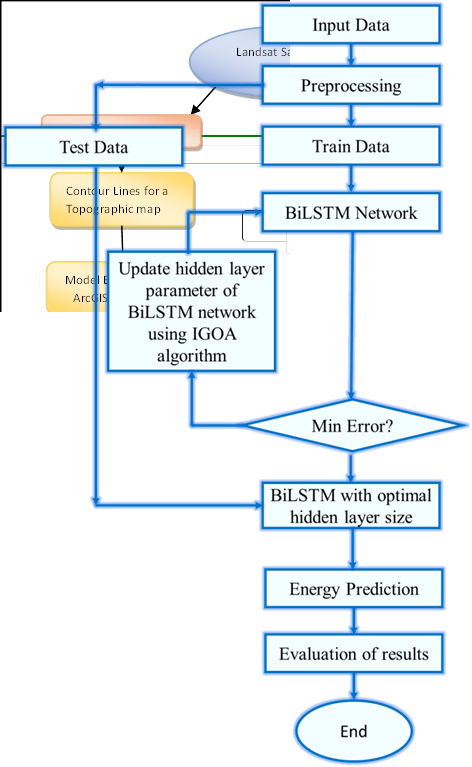
Accurate forecasting of renewable energy generation and operational variables is a critical requirement for effective smart energy management in microgrid systems. This paper presents an integrated forecasting framework based on a Bidirectional Long Short-Term Memory network optimized using an Improved Grasshopper Optimization Algorithm (IGOA-BiLSTM). The proposed method exploits the bidirectional learning capability of BiLSTM to model complex nonlinear temporal dependencies, while an enhanced Grasshopper Optimization Algorithm is introduced to optimally tune the network’s hidden layer size. The IGOA incorporates a dynamic inertia weight updating mechanism and an adaptive triangular mutation strategy to improve exploration–exploitation balance, enhance convergence stability, and avoid premature convergence. The model is evaluated using real-world hourly data from the PJM West Zone, including photovoltaic power, wind turbine power, load demand, and day-ahead electricity prices. Experimental results demonstrate that the proposed IGOA-BiLSTM achieves superior forecasting accuracy compared with conventional LSTM and state-of-the-art hybrid models. Specifically, the proposed method attains coefficients of determination (R²) of 0.99 for photovoltaic power, wind power, load demand, and day-ahead price forecasting. For photovoltaic and wind power prediction, RMSE values of 0.019 and 0.015 are achieved, respectively, with corresponding MSE values as low as 0.0003 and 0.0002. In load and day-ahead price forecasting, the model achieves RMSE values of 0.019 and 0.009, respectively. These results confirm the robustness, high accuracy, and computational efficiency of the proposed framework, making it well suited for practical microgrid energy management, renewable energy planning, and electricity market decision-support applications.
References
[1] Al-Shetwi, A. Q., Hannan, M. A., Al-Masri, H. M., & Sujod, M. Z. (2025). Latest advancements in smart grid technologies and their transformative role in shaping the power systems of tomorrow: An overview. Progress in Energy, 7(1), 012004.
[2] Meena, S. B., Patil, P. R., Kandharkar, S. R., Hemalatha, N., Khade, A., Dixit, K. K., & Chinthamu, N. (2024). The evolution of smart grid technologies: Integrating renewable energy sources, energy storage, and demand response systems for efficient energy distribution. Nanotechnology Perceptions, 1098-1109.
[3] Alhasnawi, B. N., Hashim, H. K., Zanker, M., & Bureš, V. (2025). The rising, applications, challenges, and future prospects of energy in smart grids and smart cities systems. Energy Conversion and Management: X, 101162.
[4] Gayen, D., Chatterjee, R., & Roy, S. (2024). A review on environmental impacts of renewable energy for sustainable development. International Journal of Environmental Science and Technology, 21(5), 5285-5310.
[5] Kabeyi, M. J. B., & Olanrewaju, O. A. (2023). Smart grid technologies and application in the sustainable energy transition: a review. International Journal of Sustainable Energy, 42(1), 685-758.
[6] Teixeira, R., Cerveira, A., Pires, E. J. S., & Baptista, J. (2024). Advancing renewable energy forecasting: A comprehensives review of renewable energy forecasting methods. Energies, 17(14), 3480.
[7] Amor, S. B., Möbius, T., & Müsgens, F. (2024). Bridging an energy system model with an ensemble deep-learning approach for electricity price forecasting. arXiv preprint arXiv:2411.04880.
[8] Sarathkumar, T. V., Goswami, A. K., Shuaibu, H. A., & Ustun, T. S. (2025). Wind power forecasting and economics of energy arbitrage in electricity market using machine learning techniques. Discover Sustainability, 6(1), 974.
[9] Zia, M. Z. B., Janjua, R. M. A. K., Yasir, M. T., Ali, M. H., Masood, H., & Malik, H. S. (2025). Short-Term Load Forecasting In Smart Grids Using Machine Learning: A Comparative Analysis Of Regression-Based Models. Spectrum of Engineering Sciences, 3(5), 760-772.
[10] Shahinzadeh, H., Sadrarhami, H., Hayati, M. M., Majidi-Gharehnaz, H., Abapour, M., & Gharehpetian, G. B. (2024, February). Review and comparative analysis of deep learning techniques for smart grid load forecasting. In 2024 20th CSI International Symposium on Artificial Intelligence and Signal Processing (AISP) (pp. 1-9). IEEE.
[11] Zhang, D. (2024). Optimization and research of smart grid load forecasting model based on deep learning. International Journal of Low-Carbon Technologies, 19, 594-602.
[12] Gangwar, H., Parambil Gangadharan, S. M., Daniel, L., Srinivasa Kumar, B., Hariramakrishnan, P., Ramkumar, G., ... & Ifseisi, A. A. (2023). Micro-Grid Renewable Energy Integration and Operational Optimization for Smart Grid Applications Using a Deep Learning. Electric Power Components and Systems, 1-16.
[13] Biswal, B., Deb, S., Datta, S., Ustun, T. S., & Cali, U. (2024). Review on smart grid load forecasting for smart energy management using machine learning and deep learning techniques. Energy Reports, 12, 3654-3670.
[14] Devi, S. L. R. P. S., & Krishna, C. (2025, February). Towards sustainable energy management: Load forecasting techniques in smart grids. In AIP Conference Proceedings (Vol. 3280, No. 1, p. 030005). AIP Publishing LLC.
[15] Onteru, R. R., & Sandeep, V. (2024). An intelligent model for efficient load forecasting and sustainable energy management in sustainable microgrids. Discover Sustainability, 5(1), 170.
[16] Bashir, T., Wang, H., Tahir, M., & Zhang, Y. (2025). Wind and solar power forecasting based on hybrid CNN-ABiLSTM, CNN-transformer-MLP models. Renewable Energy, 239, 122055.
[17] Wang, M., Xia, Y., & Zhang, X. (2024). Research on renewable energy power demand forecasting method based on IWOA-SA-BiLSTM modeling. Frontiers in Energy Research, 11, 1331076.
[18] khan, S., Mazhar, T., Shahzad, T., Waheed, W., Waheed, A., Saeed, M. M., & Hamam, H. (2024). Optimizing deep neural network architectures for renewable energy forecasting. Discover Sustainability, 5(1), 394.
[19] Xiong, B., Zhang, L., Hu, Y., Fang, F., Liu, Q., & Cheng, L. (2025). Deep reinforcement learning for optimal microgrid energy management with renewable energy and electric vehicle integration. Applied Soft Computing, 113180.
[20] Ramya, M., & Devaraju, T. (2025, March). Dynamic Scheduling and Islanding Energy Management in microgrids using Deep Learning and Adaptive Reinforcement Learning Techniques. In 2025 7th International Conference on Intelligent Sustainable Systems (ICISS) (pp. 1678-1682). IEEE.
[21] Sarmadi, B. K., Shayeghi, H., Seyedshenava, S., & Shafie-khah, M. (2025). Multiple microgrids intelligent energy management with capacity constraint using hybrid deep neural network and reinforcement learning. International Journal of Electrical Power & Energy Systems, 172, 111179.
[22] Boopathi, G., & Palanisamy, K. (2025). Energy management in hybrid renewable microgrids using an optimal deep learning model with attention-based transfer learning mechanism. Waves in Random and Complex Media, 1-30.
[23] Kim, H. J., and M. K. Kim. "A novel deep learning-based forecasting model optimized by heuristic algorithm for energy management of microgrid." Applied Energy 332 (2023): 120525.
[24] Alabi, Tobi Michael, Lin Lu, and Zaiyue Yang. "Data-driven optimal scheduling of multi-energy system virtual power plant (MEVPP) incorporating carbon capture system (CCS), electric vehicle flexibility, and clean energy marketer (CEM) strategy." Applied energy 314 (2022): 118997.
[25] Almousawi, Ali Q., Nabil Jalil Aklo, and Zaid Alhadrawi. "An efficient novel deep learning-based predicting model optimized by an improved DAOA algorithm for microgrid energy management." Future Technology 5.1 (2026): 303-313.
Downloads
Published
How to Cite
Issue
Section
License
Copyright (c) 2026 Safaa Ahmed Jawad Alshareefi

This work is licensed under a Creative Commons Attribution-ShareAlike 4.0 International License.